FitWhen to use it — and when not
Use it when
- Any answer drawn from documents, the web or a knowledge base
- Domains where being wrong costs money: legal, finance, health, support
- Internal tools where people must defend the answer to someone else
Skip it when
- Purely creative output with no sources
- When you cannot map claims to passages — fix retrieval first, do not fake citations
AnatomyThe parts of the pattern
- Inline markersNumbered markers right after the claim they support.
- Source listTitle, location and freshness of each source.
- Quoted snippetThe exact passage, highlighted, on hover or tap.
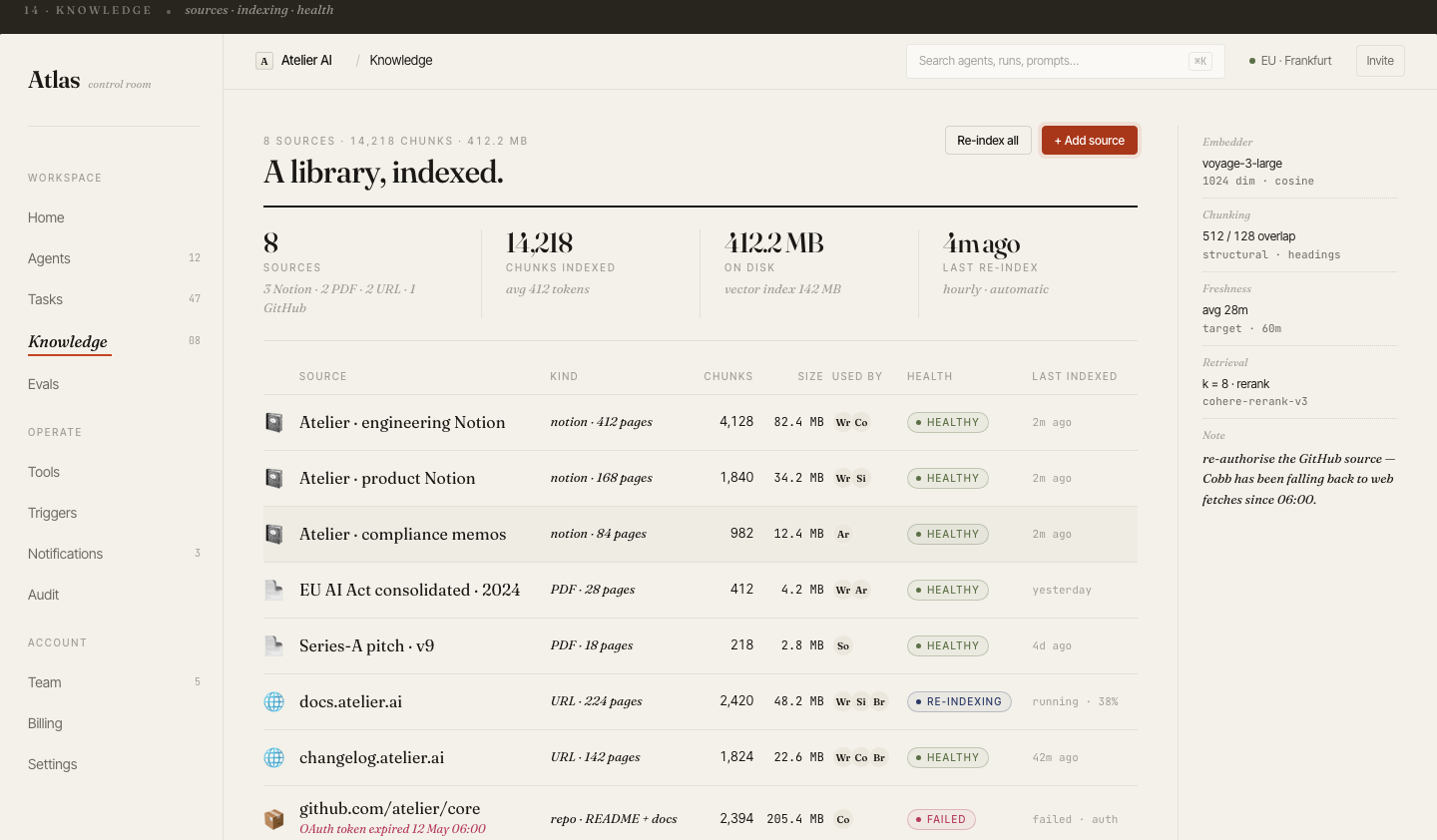
- Health signalsStale or failed sources flagged, not hidden.
GuidelinesDo & don’t
Do
- Cite at claim level, not one list at the bottom of the answer.
- Show the passage, not only the document title.
- Flag stale sources (age) and sources that failed to sync.
Don’t
- Cite a source that does not contain the claim — it destroys trust faster than no citation.
- Open sources in a way that loses the conversation.
- Treat "last indexed 3 months ago" as an admin-only detail.
In productionHow it looks in a shipped product
In the wildReal-world examples
PerplexityChatGPT searchMicrosoft CopilotNotebookLM
Products named for reference only — no affiliation, and the demo above is an original illustration, not a copy of their UI.
For engineersImplementation notes
- Return chunk ids with the answer (ask the model to cite ids, then map ids to spans) instead of asking it to write URLs.
- Store chunk offsets so the UI can highlight the exact passage in the source viewer.
- Expose index freshness and per-source sync errors through the same API the answer uses.