How to use it
- Send your AI MVP brief before the call. How a partner reacts to it is already signal.
- Ask the questions below on the call. Score each criterion from 1 (poor) to 5 (excellent) right after, while it's fresh.
- Multiply each score by its weight and add up. Maximum is 100.
- 80+ strong candidate · 60–79 workable, list the gaps and ask about them in writing · below 60 pass, however nice the portfolio is.
The nine criteria
Shipped AI products, live Weight ×3
- Ask
- Show me an AI product you designed or built that real users use today. What did the model do, and what did you design around its failures?
- What surprised you after launch?
- Good answer
- Talks about error states, latency, cost per request, evals, how users corrected the AI — and shows it working, not in a deck.
- Red flag
- Only concept shots, a chatbot skin on someone else's API, or "we've done lots of AI" without a single live link.
Speed to first working version Weight ×3
- Ask
- What will I be able to click at the end of week 2?
- When do real users touch it?
- Good answer
- A clickable prototype with real model output in week 1–2; a usable build with your data in weeks 3–6.
- Red flag
- A 4–6 week "discovery phase" with no working software at the end; a timeline that starts with "first we'll staff the team".
AI technical judgement Weight ×3
- Ask
- For our case — would you use prompting, RAG or fine-tuning, and why?
- Roughly what will one request cost us, and how would you keep it there?
- How will we know the AI got better or worse after a change?
- Good answer
- Starts with the simplest approach (prompting + tools), names when RAG is needed, estimates cost per task, and mentions an eval set unprompted.
- Red flag
- Recommends fine-tuning or a custom model by default; can't estimate cost per request; "we'll test it manually".
Design and engineering in one loop Weight ×2
- Ask
- Who writes the frontend? How does a design become code?
- Who decides when design and engineering disagree?
- Good answer
- Same person or a tight pair; designs in code or ships the design system as components; one accountable owner.
- Red flag
- Design and development in different companies; "the developers will figure out the states"; a handoff document as the main artefact.
Scope discipline Weight ×2
- Ask
- What would you cut from our brief?
- What is the riskiest assumption in it?
- Good answer
- Cuts things, explains why, and proposes how to test the riskiest assumption first.
- Red flag
- Says yes to everything; adds features to the brief; quotes before asking a single question.
Pricing, contract and ownership Weight ×2
- Ask
- Fixed price or time and materials? What exactly is included?
- Where does the code live, and when do we own it?
- Good answer
- Clear scope with a change process; code in your repository from day one; IP transfers on payment of each milestone; accounts (cloud, model API) in your name.
- Red flag
- Code in their repo until final payment; model API keys on their account; vague "phases" with no deliverables.
Who actually does the work Weight ×2
- Ask
- Who exactly will design and build this, and can I talk to them now?
- How often will I see working software?
- Good answer
- You meet the people doing the work; weekly demo of the live build; overlap with your working hours.
- Red flag
- Seniors sell, juniors deliver; weekly status reports instead of demos; "the team will be assigned after signing".
Proof from founders like you Weight ×2
- Ask
- Can I talk to two founders you built for in the last 12 months?
- Good answer
- Offers references without hesitation, including one where things went wrong and how it was handled.
- Red flag
- No references; only logos of big brands from years ago; testimonials without names.
After launch Weight ×1
- Ask
- What happens when our model provider changes a model or a bug appears in month two?
- How do you hand over?
- Good answer
- A warranty period, a documented handover (README, runbook, prompts in the repo), an optional retainer.
- Red flag
- No answer beyond "we can quote that later"; prompts and evals not part of the deliverables.
Scoring sheet
| Criterion | Weight | Partner A | Partner B | Partner C |
|---|---|---|---|---|
| Shipped AI products, live | ×3 | |||
| Speed to first working version | ×3 | |||
| AI technical judgement | ×3 | |||
| Design and engineering in one loop | ×2 | |||
| Scope discipline | ×2 | |||
| Pricing, contract and ownership | ×2 | |||
| Who actually does the work | ×2 | |||
| Proof from founders like you | ×2 | |||
| After launch | ×1 | |||
| Weighted total (max 100) |
Red flags that end the conversation
- A fixed quote before they asked about your users, data or success metric.
- They can't name a single thing that went wrong on a past AI project.
- The plan has no eval set, no error states and no cost estimate — only screens.
- Your production accounts (cloud, model API, domain, app stores) would be registered to them.
- "AI will make it 10x cheaper" with no explanation of what is still done by people.
- They push their own platform or framework that only they can maintain.
- They promise accuracy numbers ("99% accurate") before seeing your data.
- Nobody on the call has shipped the kind of interface you need (chat, agent, RAG search, copilot).
Five questions for reference calls
- What was promised for the first two weeks, and what did you actually get?
- How far did the final cost and timeline land from the original estimate — and why?
- What happened the first time you disagreed?
- Could your own team take over the code without them? Did you have to?
- Would you hire them again for the next version? What would you change?
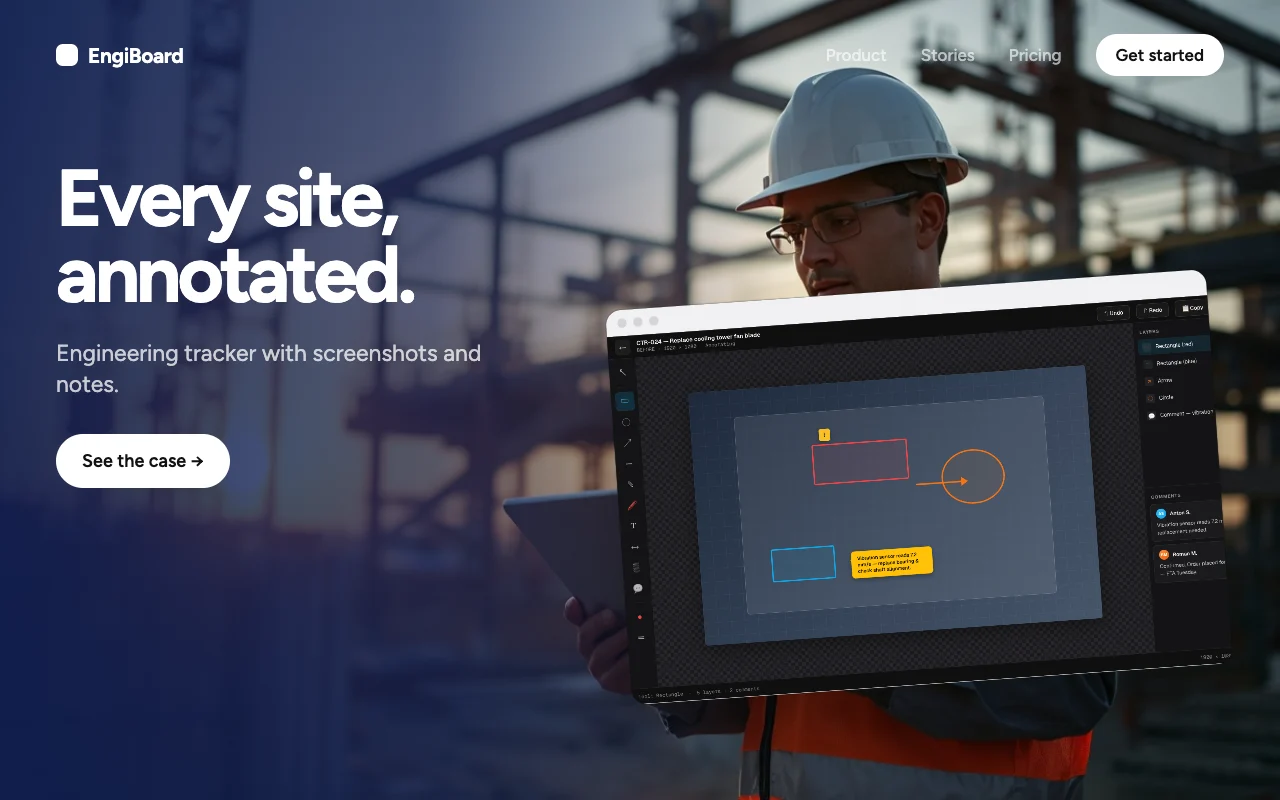 EngiBoard
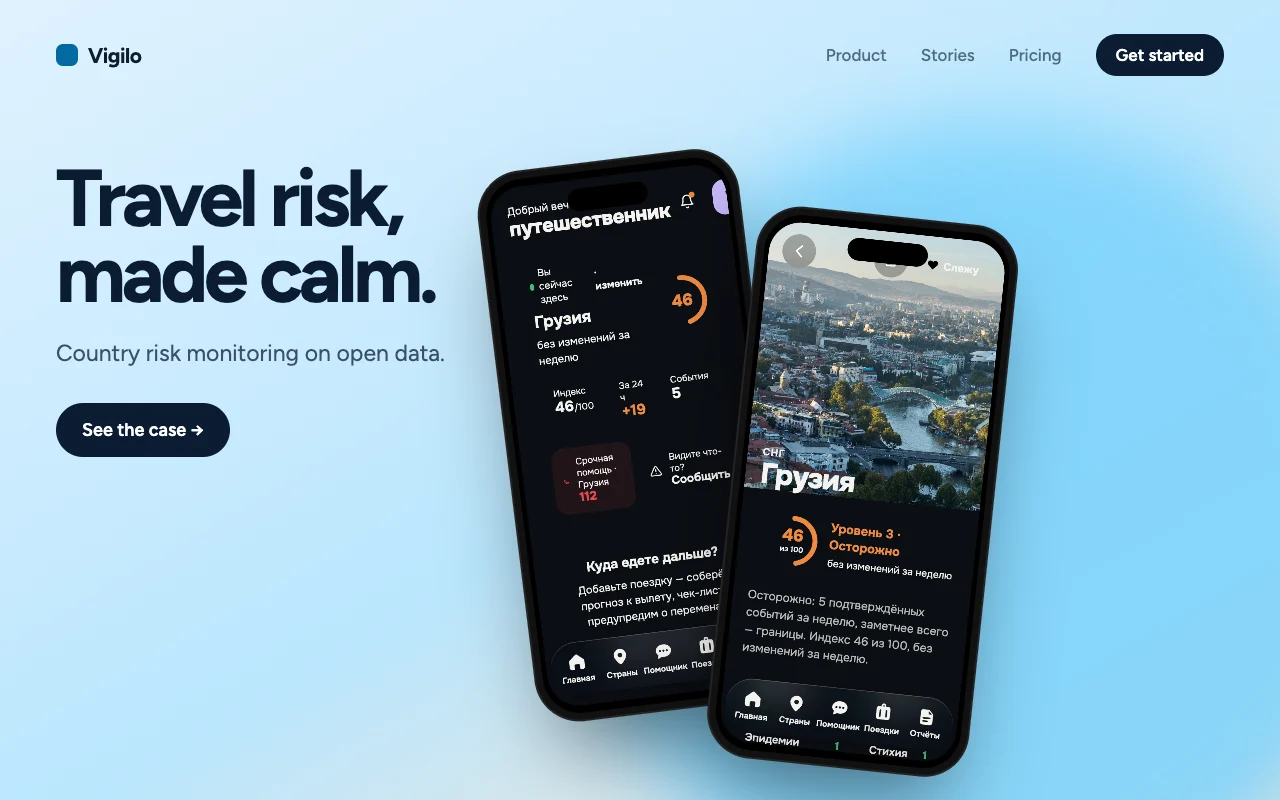 Vigilo
 AI Dent